


Toolbox Talk in Diving Operations: The First Line of Defense for Diver Safety
Toolbox Talk in Diving Operations | Diver Safety Starts Before the Dive
Learn why Toolbox Talks are essential in diving operations. Discover how pre-dive safety briefings help prevent accidents, improve communication, and protect divers.
Essam Nashat
6/12/20262 min read
Introduction
In diving operations, safety begins long before the diver enters the water. One of the most important tools for preventing accidents is the Toolbox Talk, also known as the pre-dive safety briefing. While some teams may see it as a routine meeting, experienced diving professionals understand that it is often the first line of defense against incidents and injuries.
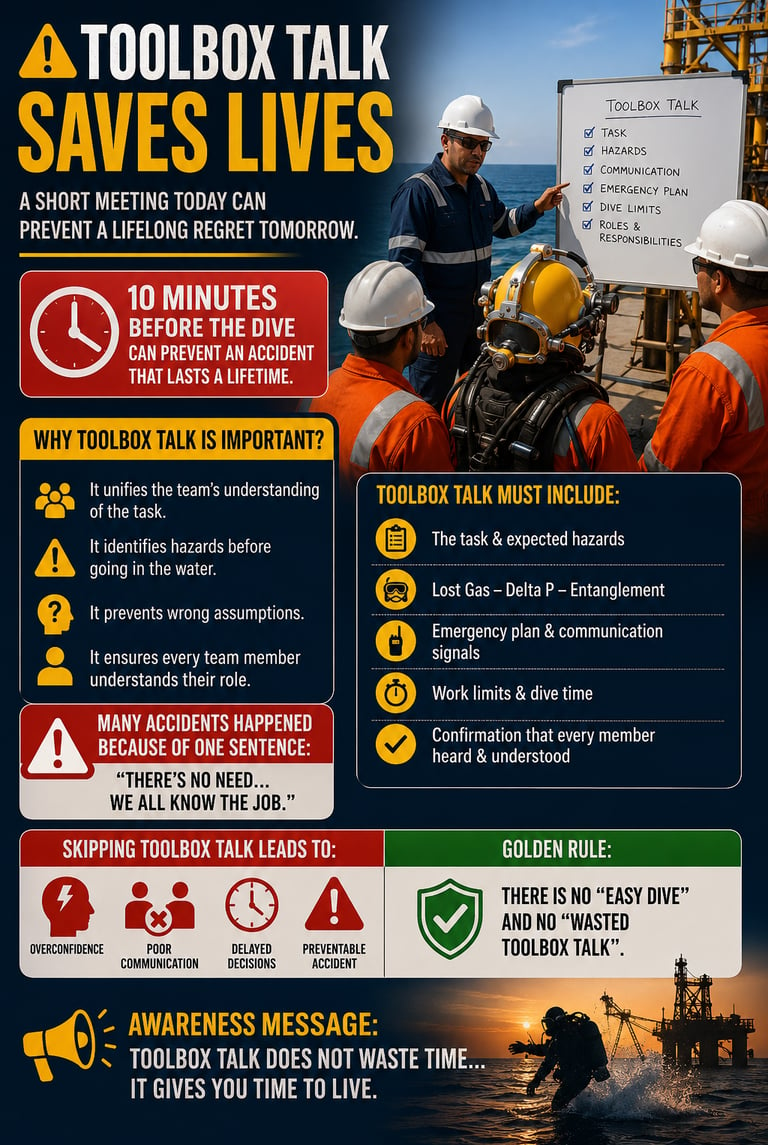
Just ten minutes spent reviewing the job can identify hazards, improve communication, and ensure that every team member understands their role before the dive begins.
Why Is Toolbox Talk Important?
Potential risks such as:
Lost Gas
Delta P (Differential Pressure)
Entanglement
Limited Visibility
Strong Currents
Topics That Should Be Covered
A proper Toolbox Talk helps the dive team:
Understand the scope of the operation.
Identify potential hazards before entering the water.
Clarify responsibilities and communication procedures.
Review emergency response actions.
Confirm that every team member understands the plan.
Many diving incidents have occurred because someone assumed that everyone already knew what to do. Effective communication eliminates assumptions and reduces risk.
Hazard Identification
A diving Toolbox Talk should include:
Dive Task and Work Scope
A clear explanation of the planned operation and expected objectives.
Emergency Procedures
Review emergency actions, evacuation plans, and communication signals.
Dive Limits
Confirm maximum depth, bottom time, and operational boundaries.
Team Responsibilities
Ensure every diver, tender, supervisor, and support team member understands their role.
The Cost of Skipping a Toolbox Talk
Skipping a safety briefing can lead to:
Poor communication
Incorrect assumptions
Delayed decision-making
Increased risk of accidents
A Toolbox Talk takes only a few minutes, but the consequences of not conducting one can last a lifetime.
A Simple Rule
There is no such thing as an “easy dive,” and there is no such thing as a “wasted Toolbox Talk.” Every dive deserves a proper safety briefing.
Conclusion
Toolbox Talks do not waste time—they protect lives. By taking a few minutes to review the task, identify hazards, and confirm team understanding, diving supervisors and team members create a safer working environment for everyone involved.
A successful dive begins with a well-prepared team, and every well-prepared team begins with a Toolbox Talk.
Contact
For training, technical support, diving consultancy, or course inquiries
© 2026 Captain Essam Nashat | Diving Education & Training.

Phone / WhatsApp